.png)
Entangled Right Whale Discovered off Georgia Coast: Crews Remove 300+ Feet of Rope in Multi-Day Rescue

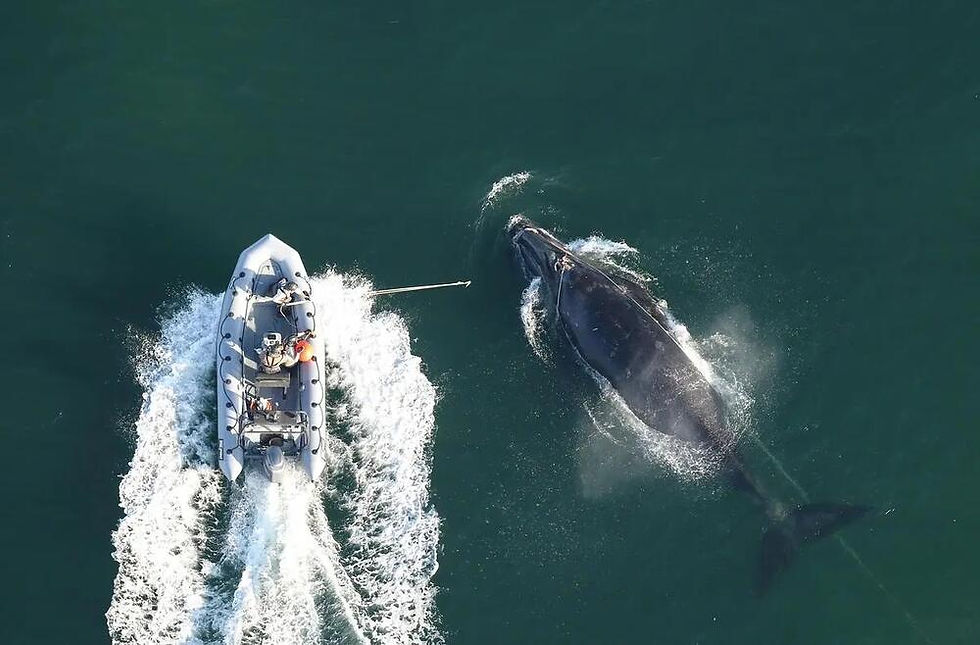
During a routine aerial survey on December 3, teams from the Florida Fish & Wildlife Conservation Commission (FWC) and Clearwater Marine Aquarium spotted something alarming roughly 10 miles off Jekyll Island, Georgia — a young North Atlantic right whale wrapped in heavy rope.
According to NOAA’s Southeast Large Whale Program Coordinator Clay George, sightings like this are rare in the Southeast, occurring only every year or two. With no fisheries active during calving season that use such heavy gear, the whale likely became entangled months earlier, sometime after its last sighting in July.
A 3-Year-Old Known as 5217, or “Division”
The whale was identified as NARW 5217, a 3-year-old male nicknamed Division for the division-symbol markings on his head. Juvenile right whales like Division often migrate south with pregnant females for the winter, placing them in the region at the start of calving season.
Aerial photos quickly confirmed that Division was carrying a long trailing rope, with some sections embedded in his tissue — particularly around the jaw and left flipper — posing risks of infection, restricted blood flow, impaired feeding, and potentially death.
Coordinated, High-Risk Response
Within hours, crews from the Georgia Department of Natural Resources (DNR), NOAA Fisheries, FWC, the Center for Coastal Studies, and two aerial survey teams mobilized. Over three days, responders worked in challenging conditions to cut away as much gear as possible without further stressing or injuring the whale.

Day One: Teams first attached a satellite tracking tag to Division, allowing them to relocate him the next day. They successfully removed 10–20 meters of heavy, lead-weighted rope trailing behind the whale — material not typical of fisheries in the Southeast.
Day Two: At daylight, a four-boat, two-aircraft response team regrouped off Jekyll Island. Using long carbon-fiber poles, cutting tools, and techniques adapted from historic whaling methods, crews attempted precise cuts on the rope embedded near Division’s left side.
After several attempts and unpredictable behavior from the distressed whale, responders deployed a “flying knife” — a V-shaped blade that, when towed behind a buoy, saws through rope as the whale swims. This successfully severed the line above the left pectoral fin.
Further inspection revealed whale lice and oily residue on the retrieved rope, confirming parts had been embedded deep into the flipper. Crews removed more than 300 feet of heavy rope in total.
What Happens Now
Division is now swimming north with a satellite buoy still attached. While crews removed significant amounts of gear, rope remains embedded in the jaw — a common and difficult-to-address injury for right whales.
Responders hope that with the asymmetrical drag caused by the remaining rope, Division will be able to work free the remaining fragments on his own. Teams along the U.S. East Coast are on alert should further intervention be necessary.
A Reminder of the Stakes
North Atlantic right whales remain one of the world’s most endangered species, with fewer than 400 individuals left. Entanglement in fishing gear is one of their most significant ongoing threats; more than 85% of right whales show evidence of past entanglements.
Despite the exhausting, high-risk operation, the rescue teams received encouraging news at the end of day two: aerial crews documented the third new mother-calf pair of the season. The mother, Callosity Back, was herself disentangled as a juvenile in 2011 — a hopeful sign that intervention efforts can make a lifelong difference.

Original story - Mary Landers, The Current - In two-day effort at sea, team partially frees whale of fishing gear off Georgia coast | Georgia Public Broadcasting

Comments